
No new system to learn. You keep sending the files you already keep, and Tarnwick does the matching, checking and calculating.
Your stock, sales, PO and shipping files arrive in a private shared folder, or your own script drops them there. We never need access to your systems.
SKU codes are matched across files, whatever each system calls them. Dates, duplicates and typos are fixed, and every fix is logged so nothing is hidden.
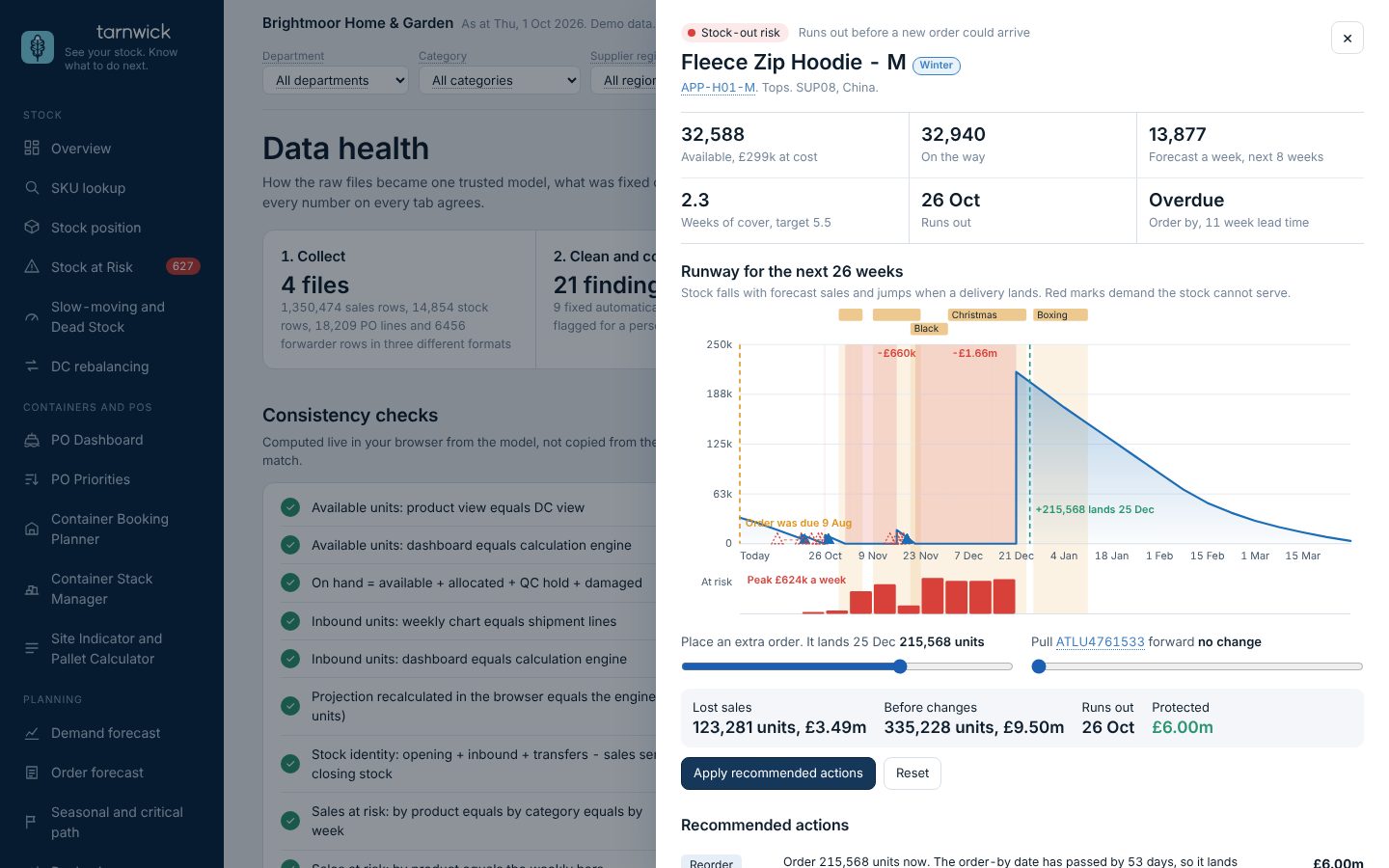
Demand is corrected for past stock-outs, forecast for 52 weeks and projected week by week, with each PO landing when it can actually be sold: ETA, plus time to clear the port and be received into the DC.
You open one page. Built-in checks recompute the headline numbers independently, so every figure agrees with the same figure everywhere else.
In the demo, several forwarders each send files with different column names, date styles and product codes. Tarnwick maps them to one layout and logs each fix.
A 30-minute video call.
We check and combine them.
Our aim: two to three weeks.
Or daily, once handed over.
Your first dashboard in a few weeks. No implementation project.
No IT project, no new system to learn, no re-keying data.
No per-user licences and no consultants on the clock.
We refresh it for you.
Your own script refreshes it.
Most customers start here.
You send files. We never need access to your systems.
Files travel by a private folder, not by email.
We only need product-level data: stock, sales, orders and shipments.
Raw files are deleted after 90 days, as set out in writing.
Tarnwick uses standard supply chain terms. Every team has its own, so during setup we map the dashboard to your words and your rules.
A single product, size and colour you stock.
You may call it: Item, article, product code, stock line
A purchase order placed with a supplier.
You may call it: Order, buy, contract
Estimated arrival date of a container at the port, or of stock at the DC.
You may call it: Landing date, arrival date, due date
The date the supplier finishes the goods and they are ready to ship.
You may call it: Ready date, cargo ready date, ship date
Time from placing a PO to the stock being sellable.
You may call it: Supplier lead time, LT, order-to-shelf
How many weeks current stock lasts against forecast sales.
You may call it: Cover, weeks stock, days of supply
The budget still available to commit to new stock, usually by month, at cost.
You may call it: Buy plan, receipts budget, intake budget
What the stock costs once it is in your DC: price, freight, duty and handling.
You may call it: Cost price, total cost, delivered cost
Demurrage and detention: charges when a container sits at the port or is kept past its free days.
You may call it: Port charges, storage and demurrage
Distribution centre or warehouse that receives and ships your stock.
You may call it: Site, depot, warehouse, FC
How far ahead a delivery can be booked, and the delivery places a DC has each day.
You may call it: Delivery slot, appointment, dock booking
Moving a PO or container later (or earlier) so stock lands when it is needed.
You may call it: Push-back, deferral, re-timing, call-off
Extra stock held to cover forecast error and supplier delay.
You may call it: Buffer, safety, minimum cover